

By Tommy Blass
If you or a loved one is seeking support for substance use, recovery, or overall chemical health, you're not alone in feeling completely confused by the range of support options. Terms like treatment, therapy, recovery coaching, peer support, chemical health services, and rehab are often used interchangeably, even though they describe very different types of support. The reality is that today's chemical health and recovery landscape has evolved significantly. Services now exist along a spectrum from highly structured medical and clinical interventions to education-focused and peer-based recovery support. Understanding the differences can help individuals and families find the right level of care at the right time.
Why is it so confusing to know which service is right for you?
Part of the confusion comes from the language itself. Terms such as recovery support, coaching, treatment, and chemical health services can mean different things. Providers might use ambiguous language or describe the same service differently.
Across the service spectrum, providers also vary in their education, experience, credentials, and licensure. Some professionals are licensed to diagnose and treat substance use disorders and mental health conditions. Others provide education, mentoring, advocacy, accountability, and recovery support without offering clinical (medical model-based) treatment. Neither approach is inherently better; they simply serve different purposes. Let’s take a closer look at the two primary service categories.
What is Clinical Treatment?
Clinical treatment follows a medical or therapeutic model and is provided by licensed professionals. These services are designed to assess, diagnose, and treat substance use disorders and, in many cases, co-occurring mental health conditions.
Examples include:
- Detoxification services
- Inpatient or residential treatment
- Outpatient treatment programs
- Individual therapy
- Group counseling
- Psychiatric services
Clinical treatment is often the most appropriate option when someone is experiencing significant impairment, mental health concerns, withdrawal symptoms, or a need for intensive therapeutic intervention. Some services are designed to respond to a crisis or stabilize an immediate situation. In these cases, treatment may be the safest and most effective first step.
What is Chemical Health and Recovery Support?
Recovery support services take a different approach. Rather than diagnosing or treating a condition, they focus on education, encouragement, accountability, skill-building, and long-term recovery success. These services are often preventative in nature and relied upon before or after a crisis. They help individuals strengthen recovery, navigate challenges, build healthy routines, and stay connected to supportive resources before problems become crises.
Examples may include:
- Recovery coaching
- Peer support (programs such as Alcoholics Anonymous)
- Recovery mentoring
- Resource navigation
- Family education
- Accountability check-ins
- Recovery planning
Recovery support recognizes that lasting change happens in everyday life, not just during appointments or treatment episodes.
Where does Northern Bridges recovery fit?
Northern Bridges Recovery provides non-clinical recovery support services designed to help individuals and families navigate recovery with greater confidence and connection. Unlike inpatient treatment centers or outpatient therapy programs, Northern Bridges does not provide clinical diagnosis, therapy, or medical treatment. Instead, services focus on practical recovery support, education, accountability, mentoring, and helping individuals stay engaged in their recovery goals.
Many people benefit from recovery support:
- After completing treatment
- During early recovery
- When seeking additional accountability
- When rebuilding healthy routines
- When family members need guidance and support
- When someone wants recovery-focused support outside of therapy sessions
Recovery support can complement treatment, but it is not a replacement for clinical care when clinical care is needed. And many people benefit from both.
Recovery support and treatment are partners, not competitors
We often say, recovery happens between appointments. While clinical care may be a one-hour session once or twice a week or a 30-day inpatient stay, real life happens at home, after work, when there’s a “trigger” (such as family conflict, isolation, and so on), having a range of resources to draw on ensures a stronger support system. Keep in mind:
- Clinical providers diagnose and treat substance use disorders and mental health conditions.
- Non-clinical organizations support recovery alongside or after treatment.
What do you need now: Treatment or Recovery Support?
The answer depends on your circumstances. Clinical treatment may be appropriate if you are experiencing:
- Withdrawal symptoms
- Significant substance use concerns
- Mental health instability
- A need for intensive therapeutic support
- Safety concerns requiring medical oversight
Recovery support may be helpful if you are:
- Maintaining recovery after treatment
- Looking for accountability and structure
- Seeking recovery-focused guidance
- Building healthy habits and routines
- Looking for additional support between appointments
- Wanting to strengthen your recovery network
Again, in many cases, the most effective approach is not choosing one or the other; it is using both.
Recovery is bigger than treatment alone
Treatment can help individuals stabilize and address clinical concerns. Recovery support helps individuals apply those lessons in everyday life, navigate challenges, and continue growing long after a treatment episode ends. If you're unsure which type of support is right for you, that's okay. The terminology can be confusing, and every person's situation is different. The most important step is reaching out and starting the conversation. With a clearer understanding of the available options, individuals and families can make informed decisions and find the support that best meets their needs.
“Treatment helps people stabilize. Recovery support helps people rebuild daily life.” – Tommy Blass
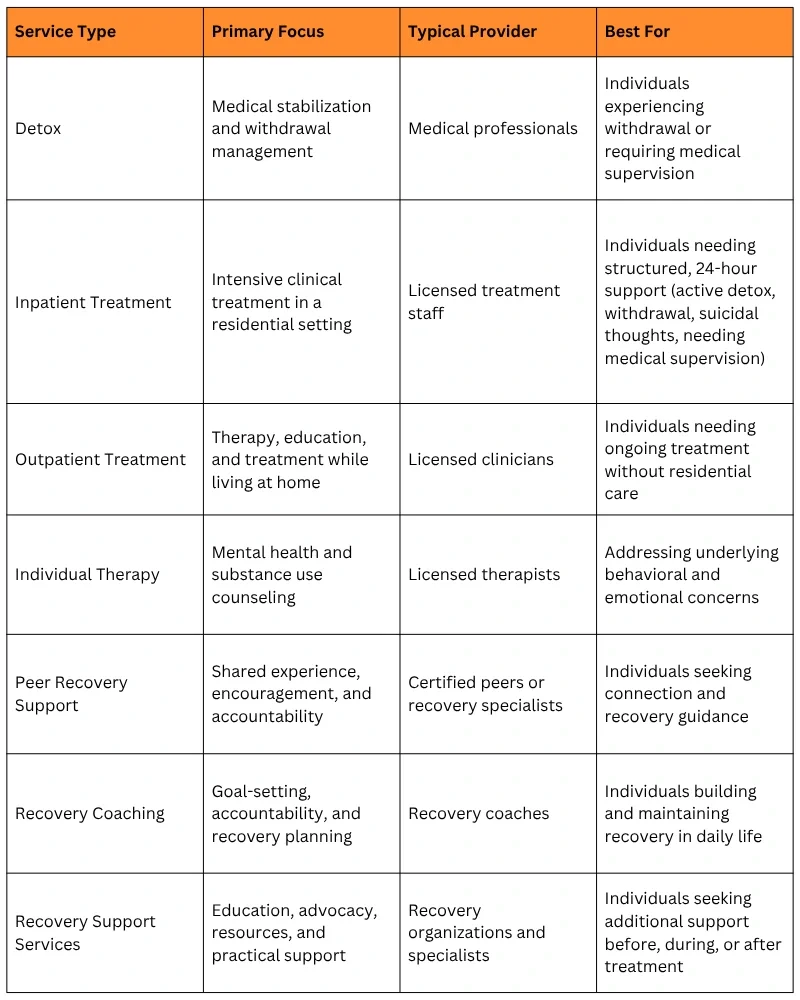
Here’s a quick guide to common chemical health and treatment services
In Closing
Working with an experienced, objective professional who possesses both long-term recovery and a Master’s level LADC provides families with the kind objectivity necessary for real guidance and support. This is becoming increasingly important as the industry has recently leaned toward using paraprofessionals with limited experience who may lack knowledge of the subtle complexities regarding what clients actually need. What is most important is providing families and individuals with solid information and the truth.
We invite you to explore Northern Bridges services or contact Tommy Blass directly with questions.